Marketing
Branding
Graphics vs Link Posts: Which Format Gets More Attention on Social Media
When the headline lives inside the image, readers stop scrolling. When it's buried in a truncated link preview, they don't. Here's what the data — and human attention — tell us about the war for the feed.
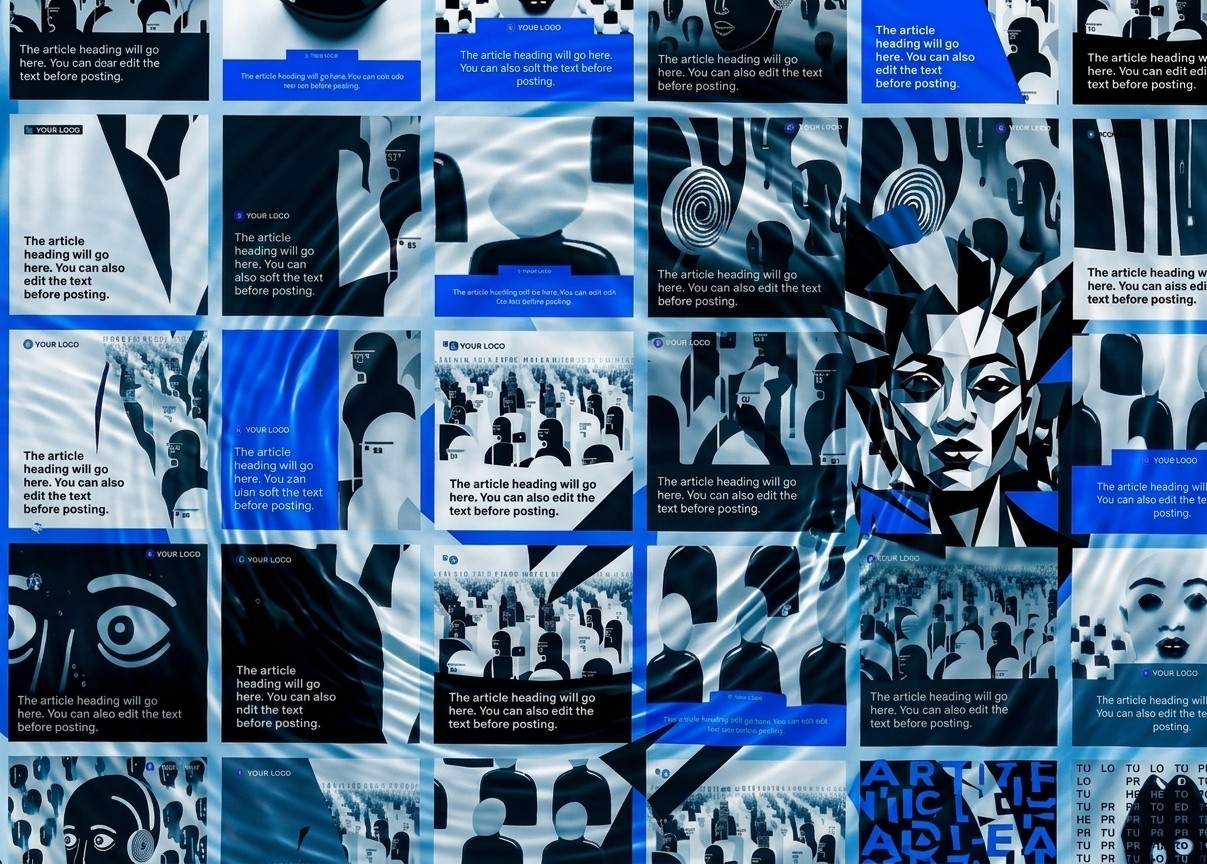
Images with a large headline embedded directly on them get significantly more reach, shares, and engagement than link-based posts on every major social platform.
Link preview cards display small, frequently truncated headlines that users scroll past; a graphic with 48px+ bold type stops the scroll and delivers the full message instantly.
Since fewer than 5% of users ever click through a link post, the graphic itself must create informational gaps to drive visitors to click, making visual format a core editorial and distribution decision, not just a design choice.
Platforms including Facebook, X, and LinkedIn algorithmically favour native image posts over external links, giving graphics a structural reach advantage before a single person engages.
Every second, millions of people scroll through their social media feeds — Facebook, Instagram, X (formerly Twitter), LinkedIn, Threads — making split-second decisions about what deserves their attention. In that fraction of a moment, one format wins almost every time: the news graphic. A bold image with the headline baked directly into it. Large. Unmissable. Impossible to truncate.
The alternative — the link post, that familiar card with a small thumbnail, a compressed title, and a snippet of description — was designed for the desktop web of 2008. In today's mobile-first, thumb-scrolling, attention-scarce social landscape, it is increasingly a loser's format.
This article examines exactly why news graphics outperform link posts, what the psychology of attention tells us about font size and image composition, and how publishers, brands, and independent creators can use this understanding to dramatically increase their reach and engagement.
3×More engagement for image posts vs. link posts on Facebook
94%Of first impressions are design-related, per attention research
0.3sTime it takes a user to decide whether to stop scrolling
The Problem with Link Posts: A Format Designed for Failure
When you share a URL on social media, the platform automatically generates an Open Graph preview card. This card typically includes a cropped thumbnail image, the domain name, a title, and a brief description. It looks clean, it feels native — and it routinely underperforms.
The reasons are structural. First, the title field in an Open Graph card has a strict character limit. On Facebook, titles are cut off at roughly 88 characters. On X, they can be truncated even shorter. On LinkedIn, mobile rendering often shows only the first line. The result is a headline that the publisher crafted carefully — with a specific rhythm, a critical final detail, a punchline word at the end — arriving to the reader as a half-sentence trailing off with an ellipsis.
Second, and more fundamentally, the font size of a link preview title is small. It is designed to be a label, not a declaration. When that preview sits in a feed next to a high-contrast image with 72-point bold white text on a dark background, it simply does not compete. The eye moves straight past it.
The feed is not a reading environment. It is a rapid-fire visual sorting environment. Content that survives that sort is content that communicates before the reader decides to engage.
How News Graphics Seize Attention — The Visual Psychology
Attention researchers distinguish between bottom-up attention (involuntary, stimulus-driven) and top-down attention (voluntary, goal-driven). In a social media feed, bottom-up attention dominates. The user is not searching for a specific piece of content; they are scanning. In this mode, certain visual properties trigger attention automatically.
1. Size and Visual Weight
Large text is processed before small text — not as a matter of preference, but as a function of visual cortex processing. A headline set at 48px or larger in a bold weight occupies a significantly larger area of the visual field than a 14px link title. It demands processing. News broadcasters have known this for decades: the lower-third chyron exists precisely because large text in a specific screen zone forces reading even from inattentive viewers.
2. Contrast and Figure-Ground Separation
White or cream text on a dark image background creates maximum luminance contrast. This contrast is one of the most powerful pre-attentive visual cues known to perception science. When a news graphic uses a dark overlay on a photograph with bright, heavy-weight type, it creates a figure-ground separation so strong that the text almost jumps off the image. Link previews, by contrast, use platform-standard dark text on a white or light-gray background — low contrast, low urgency, low visual priority.
3. Image as Emotional Prime
A well-chosen photograph does not merely illustrate the headline — it primes the emotional state that makes the headline resonate. A tightly-cropped face showing shock or concern, a dramatic wide shot of a crowd or a skyline, a symbolic object with strong cultural associations — each of these images creates an affective state in the viewer before a single word is read. That emotional priming increases the perceived relevance and urgency of the overlaid text.
Link previews use auto-cropped thumbnails chosen by the platform's scraper from whatever meta-tag the publisher specified. These are rarely composed for emotional impact. They are often a logo, a stock photo, or a cropped portion of a layout image never intended to work at 120×80 pixels.
4. The Complete Message in One Frame
A news graphic is, by design, a complete communicative unit. The reader understands the story from the image alone, without clicking, without reading a caption, without waiting for a page to load. This is critically important in the social media feed because most users will never click. Studies consistently show that on platforms like Facebook and Twitter/X, fewer than 5% of users who see a post will click through to the linked content. The other 95% form an opinion, share, or react based entirely on what they see in the feed.
If your headline is truncated and your thumbnail is illegible, the 95% who never click receive no useful information about your story. If your news graphic contains a full, legible, bold headline, those 95% receive your message — and many of them will share it, extending your reach without a single additional click.
Font Size as a Strategic Variable
Among the design choices in a news graphic, font size is arguably the single most consequential. It governs legibility at a thumbnail size (the first thing anyone sees before deciding to tap or expand), it determines how much text can fit without overcrowding, and it signals editorial authority — large type says this matters in a way that small type simply cannot.
Font Size Range | Use Case in News Graphic | Legibility at Thumbnail | Attention Impact |
|---|---|---|---|
48–72px | Main headline (1–2 lines max) | Excellent | Maximum — dominates visual field |
24–36px | Secondary line / subhead | Good | Strong — adds context without competing |
14–18px | Source, date, tag labels | Poor at small sizes | Functional only when image is expanded |
8–12px | Fine print, disclaimers | Illegible at thumbnail | Invisible in feed — wasted space |
The single most common mistake news graphics make is trying to include too much text. A graphic that contains five lines of 24px text is less effective than a graphic with two lines of 56px text. The goal is not to transfer information — it is to stop the scroll and communicate the core message before the brain decides to move on.
Breaking news broadcasters understood this intuitively: the on-screen ticker and chyron use large, high-contrast, condensed sans-serif typefaces because they need to be read at a distance, by a distracted viewer, in under three seconds. The same principle governs social media graphics. The platform is the screen; the feed is the broadcast; the viewer is always distracted.
The Algorithmic Dimension: Why Platforms Reward Graphics
Beyond human psychology, there is an algorithmic reason why news graphics outperform link posts. Every major social platform measures dwell time — how long a user's thumb pauses on a piece of content. An image that contains readable text forces a longer pause than a small link preview title, simply because it takes longer to read 10 large words than to skim past a tiny unclickable sentence.
Platforms interpret dwell time as a signal of quality and relevance. Content that receives more dwell time is shown to more users in the initial distribution window. This creates a compounding effect: the news graphic stops more thumbs, generates more dwell time, receives more algorithmic distribution, reaches more users, stops more thumbs. The link post, doing none of these things, receives minimal initial distribution and fades quickly.
Facebook has been explicit about this dynamic. Its algorithm strongly deprioritizes links that drive users off-platform, particularly when those links are to slow-loading or low-quality pages. An image post — even one that contains a URL in the caption — is treated as native content, receiving far more organic reach than an equivalent link post. This is why many major news publishers maintain separate strategies: a link post for the small percentage of users who are actively seeking to read the full story, and a graphic post for the broad reach play in the open feed.
What Makes a Great News Graphic: A Practical Framework
The best news graphics share a set of characteristics that can be distilled into a reliable production framework. Understanding these principles allows publishers and content teams to produce consistent, high-performing visual content at scale.
One Headline, Maximum Impact — Write the headline for the graphic separately from the article headline. It should be shorter, more declarative, and optimized for legibility at thumbnail size. No subordinate clauses. No hedging language.
Strong Photo Anchor — The image should contain a clear focal point: a face, a landmark, an action. Abstract backgrounds weaken the connection between image and text. The photo should emotionally prime the headline, not decorate it.
Dark Overlay or Gradient — A semi-transparent dark overlay over a portion of the image ensures that white or light-colored text remains legible regardless of the underlying photograph's brightness or color complexity.
Brand Consistency — A consistent typeface, logo placement, color palette, and layout builds brand recognition over time. Users learn to associate the visual style with the publisher, increasing trust and click rates on subsequent posts.
Minimal Text Hierarchy — Ideally: one very large headline, one small category tag or source label. Nothing more. Every additional text element reduces the visual weight of the headline and the overall stopping power of the graphic.
Mobile-First Aspect Ratio — Design for 1:1 (square) or 4:5 (portrait) formats. These occupy more screen real estate on mobile feeds than 16:9 landscape images. More screen space equals more visual dominance equals more stops.
URL in Caption, Not Embedded — Never overlay a URL on the graphic itself. Place the clickable link in the caption. The graphic's job is to stop and inform; the caption's job is to drive the click.
Platform-Specific Considerations
While the core principles apply universally, each platform has specific behaviors that inform graphic design decisions.
Facebook & Instagram
These Meta platforms are the canonical case for news graphics over link posts. Organic reach for link posts on Facebook has declined precipitously since 2014 as the platform has consistently adjusted its algorithm to favor native content. A square or portrait-ratio news graphic published as a native image post — with the article URL in the caption — routinely outperforms an equivalent link post by a factor of three to five in raw reach. Instagram, being an image-only platform by design, has never supported link posts in the feed at all, making graphics the only viable format for news content.
X / Twitter
X presents a particularly stark case. In 2023, the platform began suppressing link posts in algorithmic feeds, explicitly reducing the reach of tweets containing external URLs. In response, many publishers adopted a practice sometimes called "link withholding" — publishing the news graphic as a native image with bold embedded text, then either replying with the link or including it in the first comment. The result is a post that receives full algorithmic distribution while still providing a path to the full article.
LinkedIn's feed is dominated by professional content, and news graphics here benefit from a slightly different dynamic. On LinkedIn, the graphic signals editorial seriousness and authority. A well-designed news graphic from a recognizable brand or publication receives substantially higher engagement than a link post, particularly because LinkedIn's link preview cards are visually drab and the headline font is small on mobile. Bold graphics stand out dramatically against the platform's relatively austere visual environment.
Threads & Emerging Platforms
Newer platforms like Threads, which launched without any link preview functionality at all, have made the news graphic the default unit of shareable news content by design. This represents a broader direction of travel: as platforms optimize more aggressively for native engagement, the link post becomes less viable, and the self-contained visual format becomes more essential.
Production Checklist — Before You Post
Is the headline font 48px or larger in the full-resolution graphic?
Does the text have sufficient contrast against the background (4.5:1 minimum ratio)?
Is the full headline visible — no truncation, no overflow?
Is the URL in the caption, not embedded in the image?
Is the graphic formatted in 1:1 or 4:5 ratio for mobile feeds?
Does the image emotionally connect to the headline's subject?
Is there a clear brand mark or source label?
The Deeper Shift: From Distribution to Communication
The rise of the news graphic is not merely a tactical shift in social media strategy. It represents a deeper change in the relationship between publishers and audiences — a shift from distribution thinking to communication thinking.
Distribution thinking asks: how do I get a link to my article in front of as many people as possible? Communication thinking asks: what do I want people to understand, and what is the most direct visual path to that understanding?
When the answer to the second question is a large, bold, emotionally resonant image with a complete headline in 60-point type, the news graphic is not a workaround for a broken algorithm. It is the most honest and effective form the message can take in the context where it will be received.
The link post will always have its place — for readers actively seeking to read the full text of an article, a clean, well-structured link remains the most efficient path. But in the open feed, where attention is a zero-sum competition and the scroll never stops, the news graphic is not just a better format. It is the format that respects both the story and the audience.
Make the text big. Make the image strong. Keep the headline whole. The rest will follow.